


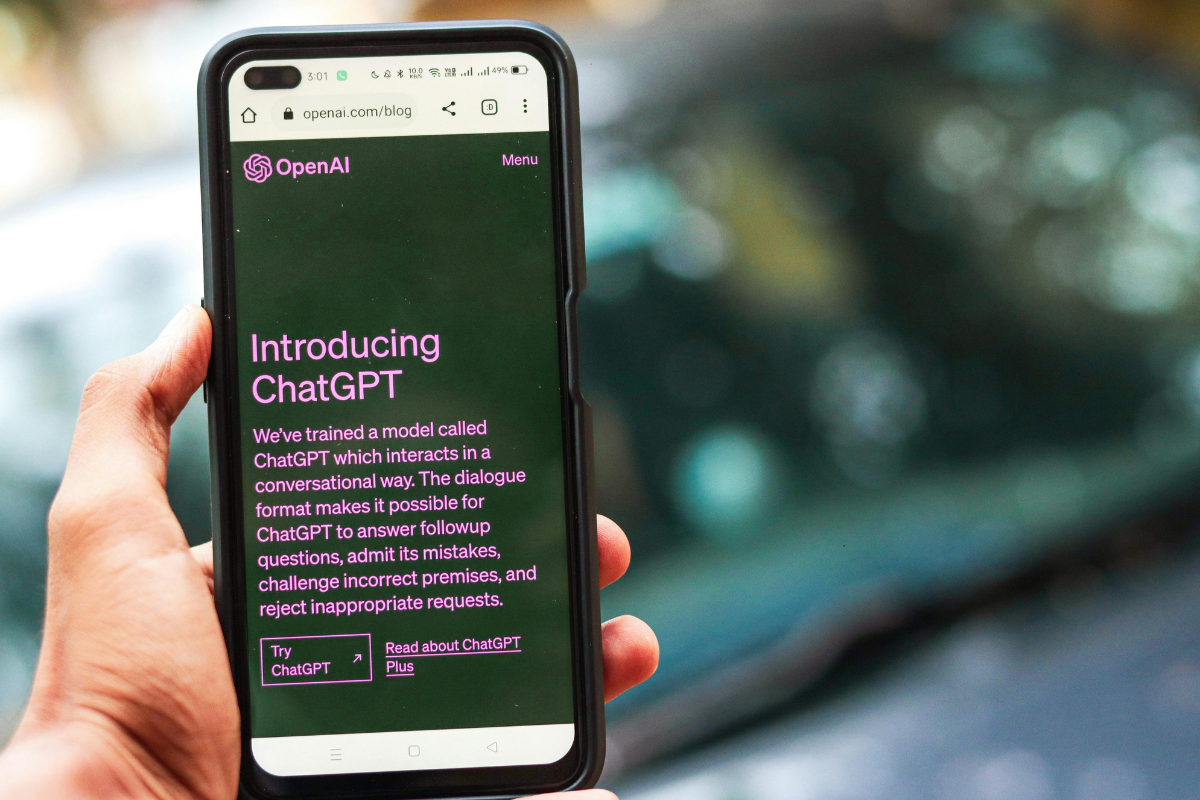
In 2026, it's almost impossible to go a day without hearing about artificial intelligence. Between headlines announcing an “unprecedented revolution” and viral videos showcasing its potential, AI is now part of our everyday vocabulary. And it no longer just sits there: it drafts our emails, summarizes our meetings and, more and more, completes entire tasks on our behalf.
Yet ask ten people what AI really is and you'll probably get ten different answers. For some, AI means ChatGPT, Claude or Gemini. For others, it's a self-driving car or Netflix's recommendation engine. And truth be told, they're all right. Each of these examples represents a different type of AI, and we'll see which one as this article unfolds.
At its core, artificial intelligence is the ability of machines to replicate certain aspects of human intelligence, such as learning, reasoning, creating or making decisions.
These systems learn from data, and they are continuously improved by retraining them or feeding them more recent data. It's a field at the crossroads of mathematics, computer science and the behavioural sciences, where logic meets the full complexity of human nature.
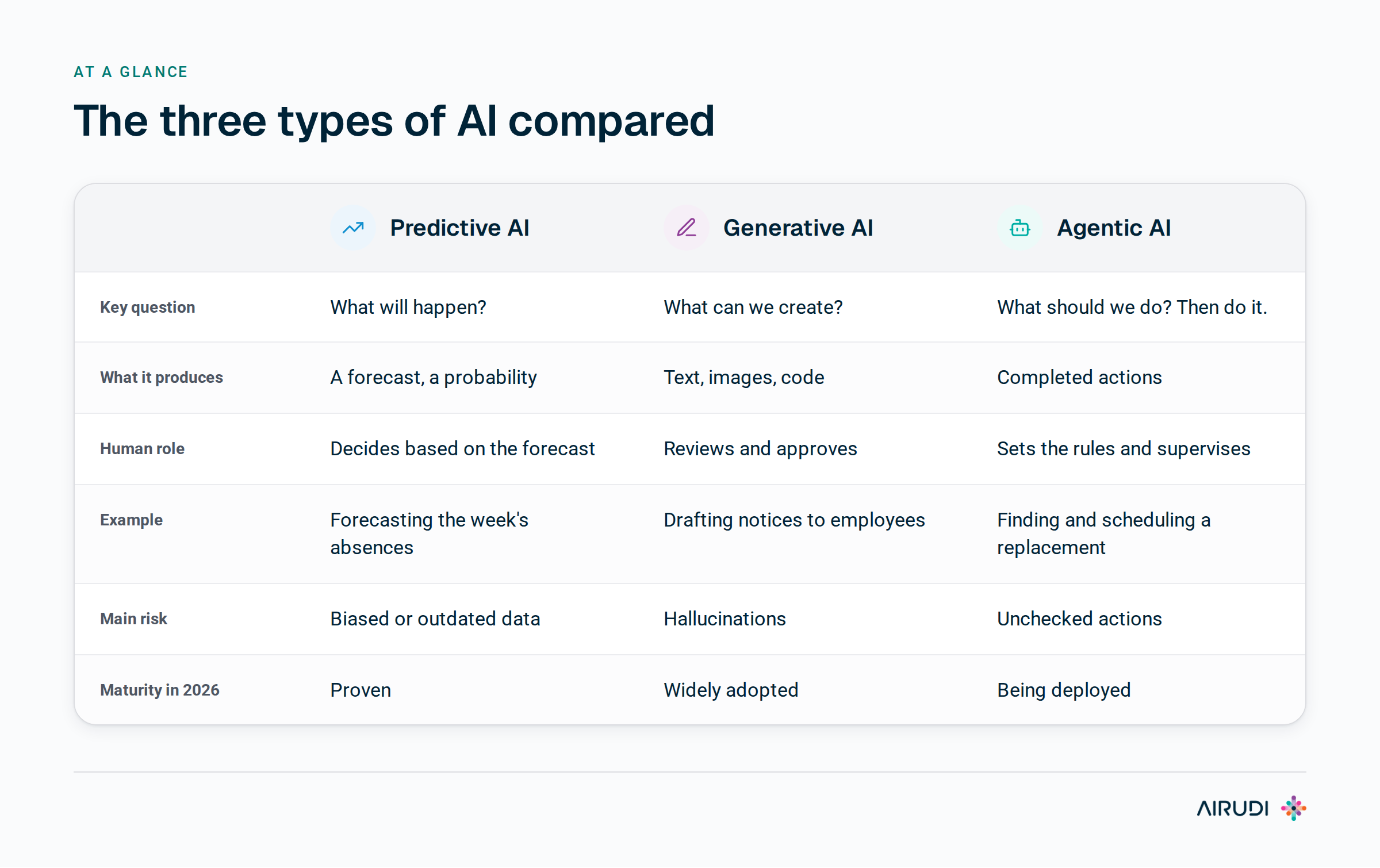
To better understand this vast field, let's explore the three main types of AI that are already shaping our world: predictive, generative and agentic intelligence. One clarification before we begin: these three families don't live in silos. In 2026, they are increasingly combined within the same solutions, which is precisely what makes the distinction so useful.
Predictive AI is the most proven form of artificial intelligence in business. Its goal? To forecast what is likely to happen based on trends observed in the past. Netflix's recommendation engine, which guesses the next series you'll want to watch, is a perfect example.
Predictive models rely on machine learning algorithms that process large volumes of historical data to identify trends and correlations. By recognizing recurring patterns, they can estimate the probability of certain future outcomes.
Predictive AI doesn't replace human decision-making: it enhances it. Think of it as a data-driven advisor telling you: “Here's what could happen if nothing changes.” It's a modern crystal ball, grounded in data rather than intuition.
However, as with any advisor, the quality of its recommendations depends on the quality of the data behind them. Incomplete or biased data leads to biased predictions. And when the context changes suddenly, whether through a pandemic or a new regulation, the past becomes a less reliable guide. That's why governance and continuous evaluation are essential to avoid biased or inaccurate predictions.
Some organizations take predictive analytics even further with prescriptive AI, which doesn't just anticipate an event, but also recommends the best course of action.
In other words, we move from “What could happen?” to “What should we do?”
Examples:
We'll come back to this bridge between prediction and action with agentic AI, which takes the next step: acting. But first, let's talk about creation.
If predictive AI helps you plan, generative AI helps you create. It's the technology at the heart of the creative explosion that began in late 2022, driven by tools like ChatGPT, Claude, Gemini, Midjourney and Suno. So those who associate AI with ChatGPT, Claude or Gemini are thinking of generative AI.
Generative models, such as large language models (LLMs), are trained on massive datasets made up of text, images, code and audio. They learn the underlying structures of language and context, which allows them to produce original content from a simple prompt.
Generative AI in 2026 has little in common with its early days. Three developments deserve your attention:
Generative AI acts as a creative copilot: it speeds up ideation and production, allowing people to focus on strategy, storytelling and innovation.
Picture a lightning-fast intern who drafts ten versions of your concept while you drink your morning coffee… although you'll still need to review their work before sending it out!
And that's exactly where the problem lies. Even though they are far more reliable than in their early days, generative models can still “hallucinate,” meaning they can confidently state something false. They also raise questions about confidentiality (what data are we entrusting them with?) and intellectual property. The rule therefore remains simple: anything that leaves the organization or commits to a decision goes through human review.
Welcome to the next frontier: agentic AI. In 2025, everyone was talking about it. In 2026, organizations are putting it into production. According to Mayfield's 2026 CXO survey of 266 technology leaders, more than 72% of large enterprises already have agents in production or in pilot projects.
Unlike predictive or generative AI, which analyze or create, agentic AI acts. The self-driving car mentioned in the introduction is a good illustration: it perceives its environment, decides on its path and takes action, without a driver.
An AI agent works in a loop and combines several capabilities:
These agents often rely on advanced language models such as GPT, Claude or Gemini, but they are integrated into the company's tools, processes and objectives. The good news: since 2025, open standards like the Model Context Protocol (MCP) have greatly simplified this integration. An agent can now consult payroll software, a calendar or a CRM without custom development for each one. Agents can also work together, each responsible for part of the job.
Agentic AI isn't just an assistant: it's a digital colleague capable of orchestrating complete processes from end to end.
Of course, the more a system acts on its own, the more costly its mistakes can be. Gartner predicts that over 40% of agentic AI projects will be cancelled by the end of 2027, due to escalating costs, unclear business value or inadequate risk controls. The firm also warns against “agent washing,” the practice of rebranding simple chatbots or automation tools as “agents.”
In other words, a well-governed agent knows what it's allowed to do, asks a human for approval before sensitive actions and keeps a record of every decision it makes.
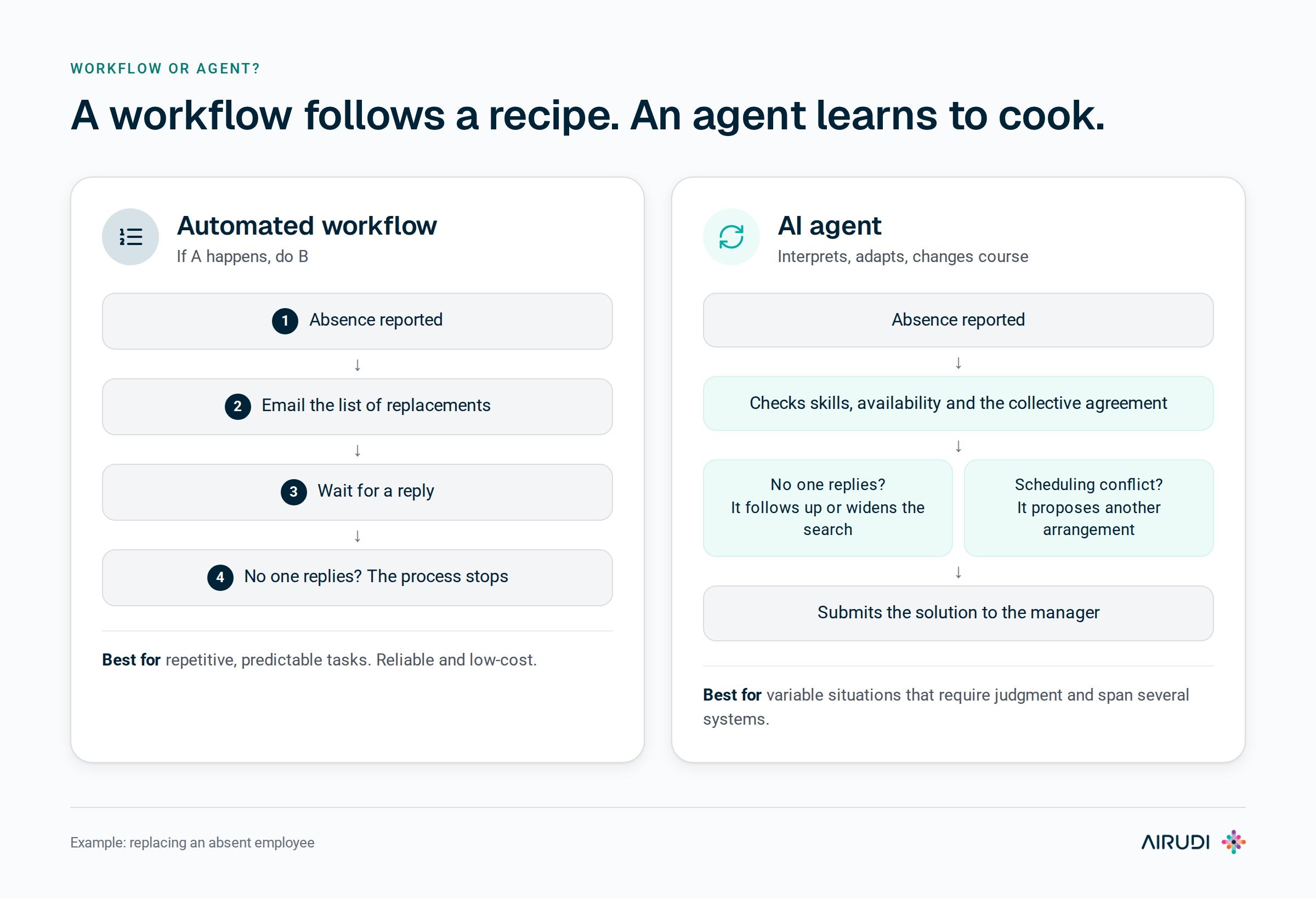
While both automate tasks, automated workflows follow predefined sequences: if A happens, do B. AI agents, on the other hand, can interpret context, adapt and redefine their path as they go.
Think of it this way: a workflow follows a recipe, while an agent learns to cook with the ingredients on hand.
And the recipe still has its place! For a repetitive, predictable task, a classic workflow is often more reliable and less costly than an agent.
What makes this evolution particularly interesting is that these three forms of AI can work together rather than in silos. And in 2026, real value increasingly comes from this combination.
Take a distribution centre on a Monday morning:
People continue to oversee the process, but they no longer spend their morning on the phone. The system runs smoothly: faster, more efficiently and with less stress for everyone involved.
Artificial intelligence is evolving at an incredible pace. But whether it's predictive, generative or agentic, the goal remains the same: improving productivity, agility and competitiveness.
Understanding these distinctions is a first step towards strategic AI adoption. Too many organizations rush to “do AI” without having determined which business problem they're actually trying to solve. Before choosing a technology, ask yourself these questions instead:
And if the task is simple and always the same? A classic automated workflow may be all you need. Sometimes the best answer isn't the newest technology.
At Airudi, we help leaders see clearly: we identify high-impact use cases, deploy the right technologies with strong governance, and turn data into measurable results.
From demand forecasting to workforce optimization, including automated replacements and proactive risk management, we help organizations make AI a true competitive advantage.
Today, everyone is talking about AI. What makes the difference is knowing where to apply it so it truly creates value. And that's exactly where we come in: to turn complexity into clarity, and data into performance.
Want to know which type of AI would have the greatest impact in your organization? Book an assessment with our team.



© Copyright 2026 |